[고1] 2025년 06월 – 35번: 기억이 과거 경험을 바탕으로 재구성되는 상상적 과정이라는 점
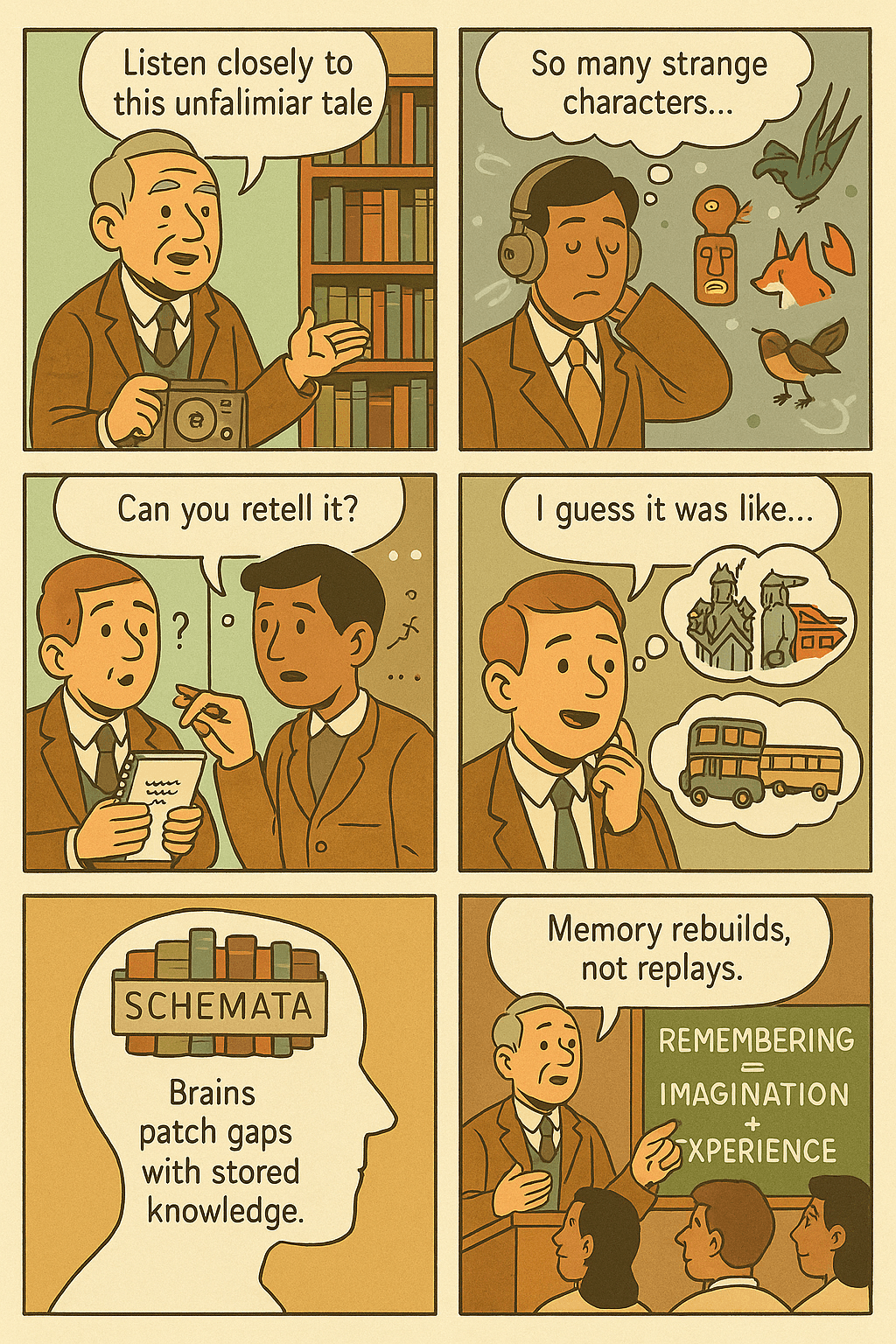
In the 1930s, the British psychologist Sir Frederic Bartlett asked people to listen to folktales from other countries and then recall these stories at a later date. As you might guess, unfamiliar stories were not remembered as well as familiar stories. Surprisingly, however, errors in memory were not random. Rather, subjects often rewrote similar parts of the stories in their own minds ─ particularly the parts that made the least sense to them. Bartlett concluded that when facing problems, humans draw upon mental schemata, or shelves of stored knowledge in our brains, to fill in any minor gaps in our memories. Therefore, remembering is an imaginative process that involves building upon past experiences.
| 구분 | 내용 | 원문 |
| 배경 설명 | 1930년대 바틀렛은 사람들에게 외국 민담을 듣고 나중에 기억해보게 하는 실험을 실시한다 | In the 1930s, the British psychologist Sir Frederic Bartlett asked people to listen to folktales from other countries and then recall these stories at a later date. |
| 결과 | 익숙하지 않은 이야기는 익숙한 이야기보다 잘 기억되지 않는다 | As you might guess, unfamiliar stories were not remembered as well as familiar stories. |
| 증거 | 기억 오류는 무작위가 아니라 이해 안 되는 부분을 재구성한다 | Surprisingly, however, errors in memory were not random. Rather, subjects often rewrote similar parts of the stories in their own minds ─ particularly the parts that made the least sense to them. |
| 주장 | 인간은 기억의 틈을 메우기 위해 뇌에 저장된 도식에 의존한다 | Bartlett concluded that when facing problems, humans draw upon mental schemata, or shelves of stored knowledge in our brains, to fill in any minor gaps in our memories. |
| 결론 | 따라서 기억은 과거 경험을 바탕으로 창의적으로 재구성되는 과정이다 | Therefore, remembering is an imaginative process that involves building upon past experiences. |
| 번호 | 문제 지문 | 원문 지문 |
| 1 | In the 1930s, the British psychologist Sir Frederic Bartlett asked people to listen to folktales from other countries and then recall these stories at a later date. | In the 1930s, the British psychologist Sir Frederic Bartlett asked people to listen to folktales from other countries and then recount these stories at a later date. |
| 2 | As you might guess, unfamiliar stories were not remembered as well as familiar stories. | As you might guess, unfamiliar stories were not remembered as well as familiar stories. |
| 3 | Surprisingly, however, errors in memory were not random. | More surprising, however, was that errors in memory were not random. |
| 4 | Rather, subjects often rewrote similar parts of the stories in their own minds ─ particularly the parts that made the least sense to them. | Rather, subjects often rewrote similar parts of the stories in their own minds—particularly the parts that made the least sense to them. |
| 5 | Bartlett concluded that when facing problems, humans draw upon mental schemata, or shelves of stored knowledge in our brains, to fill in any minor gaps in our memories. | Bartlett concluded that when facing problems, humans draw upon mental schemata, or shelves of stored knowledge in our brains, to fill in any minor gaps (or possible subproblems) in our memories. |
| 6 | Therefore, remembering is an imaginative process that involves building upon past experiences. | Therefore, remembering is an imaginative process that involves building upon past experiences. |
| 7 | Once again, this step allows you to alter your idea and how you express it. | |
| 8 | If people don’t remember what you most want them to, continue to misunderstand, or show any of the emotions you want your idea to provoke, then adjust what you say accordingly. | |
| 9 | This might change your idea statement, which might change your Choice Map, which might change some part of your full Choice Map—which is useful. | |
| 10 | It’s all a part of the refining process. | |
| 11 | And the more artfully this is done, the clearer and more concise your idea will be. |
* 원문 참고 어휘
- recount 이야기하다, 자세히 말하다 (= recall)
- More surprising 더욱 놀랍게도 (= Surprisingly)
- provoke 유발하다
- accordingly 그에 맞추어
- refine 다듬다, 정제하다
- artfully 솜씨 좋게, 능숙하게
- concise 간결한
관련 자료 바로가기
[고1] 2025년 6월 모의고사 - 한줄해석
안녕하세요, Flow 영어연구소입니다. 2025년도 6월 고1 영어 모의고사>의 한줄해석 자료 올립니다.설명문/실용문을 포함 모든 지문을 대상으로 작업했습니다. 자료는 PDF와 Word 파일 모두 올립니다.
flowedu.tistory.com
[고1] 2025년 6월 모의고사 - 한줄해석 (좌지문 우해석)
안녕하세요, Flow 영어연구소입니다. 오늘은 2025년도 6월 고1 영어 모의고사>의 한줄해석(좌지문 우해석) 자료 올립니다.설명문/실용문 포함 전지문 작업했습니다. 자료는 PDF와 Word 파일 모두 올립
flowedu.tistory.com
[고1~고3] 2025년 6월 모의고사 - 지문 정리 (문제 제작용 hwp 한글 파일)
안녕하세요, Flow 영어연구소입니다. 오늘은 2025년도 6월 고1~3 영어 모의고사>의 지문 텍스트만한글 파일 hwp와 pdf 파일로 정리해서 올립니다.변형문제 출제를 위해 해당 지문들을 hwp 한글 파일로
flowedu.tistory.com
[고1] 2025년 6월 모의고사 - 지문 요약 by ChatGPT-4.1-mini
안녕하세요, Flow 영어연구소입니다.오늘은 2025년도 6월 고1 영어 모의고사>의 지문 요약 자료 올립니다.ChatGPT 유료 버전(ChatGPT-4.1-mini)으로 작업했고,설명문/실용문을 제외한 전지문을 포함했습니
flowedu.tistory.com
[고1] 2025년 6월 모의고사 - 지문별 핵심 한글 정리 by ChatGPT-4.1-mini
안녕하세요, Flow 영어연구소입니다.오늘은 2025년도 6월 고1 영어 모의고사>의 지문별 핵심 한글 정리 자료 올립니다.ChatGPT 유료 버전(ChatGPT-4.1-mini)으로 작업했고,설명문/실용문을 제외한 전지문
flowedu.tistory.com
'[고1] 영어 모의고사 자료 > [고1] 25년 6월 자료' 카테고리의 다른 글
| [고1] 2025년 6월 모의고사 39번 - 지문 구성, 그림 설명, 원문 비교 (0) | 2025.06.13 |
|---|---|
| [고1] 2025년 6월 모의고사 38번 - 지문 구성, 그림 설명, 원문 비교 (0) | 2025.06.13 |
| [고1] 2025년 6월 모의고사 37번 - 지문 구성, 그림 설명, 원문 비교 (0) | 2025.06.12 |
| [고1] 2025년 6월 모의고사 36번 - 지문 구성, 그림 설명, 원문 비교 (0) | 2025.06.12 |
| [고1] 2025년 6월 모의고사 34번 - 지문 구성, 그림 설명, 원문 비교 (0) | 2025.06.12 |
| [고1] 2025년 6월 모의고사 33번 - 지문 구성, 그림 설명, 원문 비교 (0) | 2025.06.12 |
| [고1] 2025년 6월 모의고사 32번 - 지문 구성, 그림 설명, 원문 비교 (0) | 2025.06.12 |
| [고1] 2025년 6월 모의고사 31번 - 지문 구성, 그림 설명, 원문 비교 (0) | 2025.06.11 |
커피 한잔의 후원은 콘텐츠 제작에 큰 힘이 됩니다
(모바일에서는 배너를 클릭해 주세요)