[고1] 2025년 06월 – 33번: 소수의 자손에게 많은 에너지를 투자하는 번식 전략의 성공 요인
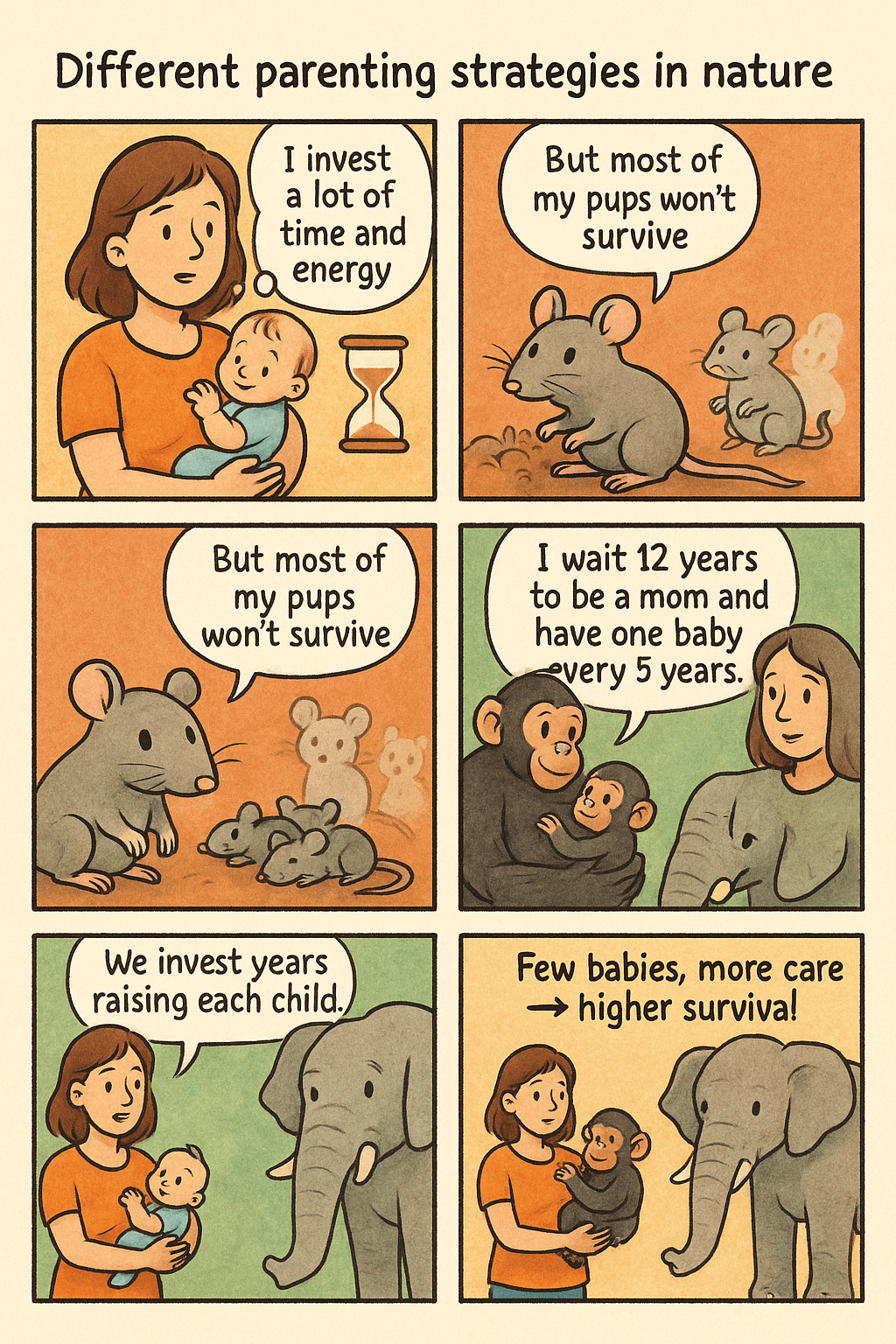
In most respects, humans are one of a relatively small number of species that evolved a very different strategy of investing more energy to reproduce more slowly. Like apes and elephants, we mature at a leisurely pace, grow large bodies, and have few babies but devote much time and energy to raising them well. This unusual strategy succeeds because while apes and elephants produce fewer babies than mice, a larger percentage of their offspring survive to then reproduce. A house mouse can become a mother when she is just five weeks old, has four to ten pups per litter, and can have a new litter every two months over the course of her approximately twelve-month life. However, the vast majority of her pups die young. In contrast, a chimp or elephant mother does not reproduce until she is at least twelve years old, and she gives birth to only one infant every five or six years over the next thirty or so years. About half of these offspring make it to becoming parents.
| 구분 | 내용 | 원문 |
| 주장 | 인간은 에너지를 많이 쓰며 천천히 번식하는 전략을 택한다 | In most respects, humans are one of a relatively small number of species that evolved a very different strategy of investing more energy to reproduce more slowly. |
| 배경 설명 | 유인원·코끼리처럼 우리는 늦게 성장하고 적은 자녀를 정성껏 키운다 | Like apes and elephants, we mature at a leisurely pace, grow large bodies, and have few babies but devote much time and energy to raising them well. |
| 근거 | 적게 낳아도 생존률이 높아 이 전략이 성공한다 | This unusual strategy succeeds because while apes and elephants produce fewer babies than mice, a larger percentage of their offspring survive to then reproduce. |
| 예시 | 집쥐는 빠르게 많이 낳지만 대부분 어린 나이에 죽는다 | A house mouse can become a mother when she is just five weeks old, has four to ten pups per litter, and can have a new litter every two months over the course of her approximately twelve-month life. However, the vast majority of her pups die young. |
| 대조 | 침팬지·코끼리는 늦게 적게 낳아도 절반 정도가 부모가 된다 | In contrast, a chimp or elephant mother does not reproduce until she is at least twelve years old, and she gives birth to only one infant every five or six years over the next thirty or so years. About half of these offspring make it to becoming parents. |
| 번호 | 문제 지문 | 원문 지문 |
| 1 | In most respects, humans are one of a relatively small number of species that evolved a very different strategy of investing more energy to reproduce more slowly. | In most respects, humans are one of a relatively small number of species that evolved a very different strategy of investing more energy to reproduce more slowly. |
| 2 | Like apes and elephants, we mature at a leisurely pace, grow large bodies, and have few babies but devote much time and energy to raising them well. | Like apes and elephants, we mature at a leisurely pace, grow large bodies, and have few babies but devote much time and energy to raising them well. |
| 3 | This unusual strategy succeeds because while apes and elephants produce fewer babies than mice, a larger percentage of their offspring survive to then reproduce. | This unusual strategy succeeds because while apes and elephants produce fewer babies than mice, a larger percentage of their offspring survive to then reproduce. |
| 4 | A house mouse can become a mother when she is just five weeks old, has four to ten pups per litter, and can have a new litter every two months over the course of her approximately twelve-month life. | A house mouse can become a mother when she is just five weeks old, has four to ten pups per litter, and can have a new litter every two months over the course of her approximately twelve-month life. |
| 5 | However, the vast majority of her pups die young. | However, the vast majority of her pups die young. |
| 6 | In contrast, a chimp or elephant mother does not reproduce until she is at least twelve years old, and she gives birth to only one infant every five or six years over the next thirty or so years. | In contrast, a chimp or elephant mother does not reproduce until she is at least twelve years old, and she gives birth to only one infant every five or six years over the next thirty or so years. |
| 7 | About half of these offspring make it to becoming parents. | About half of these offspring make it to becoming parents. |
| 8 | This strategy of high investment—live slow, die old, and reproduce conservatively—can evolve only when resources are predictable and infant mortality is low. |
* 원문 참고 어휘
- high investment 높은 투자
- live slow 천천히 살다
- die old 나이 들어 죽다
- reproduce conservatively 보수적으로 번식하다 (자손을 최대한 적게 낳는 것을 의미함)
- resources 자원
- predictable 예측 가능한
- infant 유아, 젖먹이
- mortality 사망률
관련 자료 바로가기
[고1] 2025년 6월 모의고사 - 한줄해석
안녕하세요, Flow 영어연구소입니다. 2025년도 6월 고1 영어 모의고사>의 한줄해석 자료 올립니다.설명문/실용문을 포함 모든 지문을 대상으로 작업했습니다. 자료는 PDF와 Word 파일 모두 올립니다.
flowedu.tistory.com
[고1] 2025년 6월 모의고사 - 한줄해석 (좌지문 우해석)
안녕하세요, Flow 영어연구소입니다. 오늘은 2025년도 6월 고1 영어 모의고사>의 한줄해석(좌지문 우해석) 자료 올립니다.설명문/실용문 포함 전지문 작업했습니다. 자료는 PDF와 Word 파일 모두 올립
flowedu.tistory.com
[고1~고3] 2025년 6월 모의고사 - 지문 정리 (문제 제작용 hwp 한글 파일)
안녕하세요, Flow 영어연구소입니다. 오늘은 2025년도 6월 고1~3 영어 모의고사>의 지문 텍스트만한글 파일 hwp와 pdf 파일로 정리해서 올립니다.변형문제 출제를 위해 해당 지문들을 hwp 한글 파일로
flowedu.tistory.com
[고1] 2025년 6월 모의고사 - 지문 요약 by ChatGPT-4.1-mini
안녕하세요, Flow 영어연구소입니다.오늘은 2025년도 6월 고1 영어 모의고사>의 지문 요약 자료 올립니다.ChatGPT 유료 버전(ChatGPT-4.1-mini)으로 작업했고,설명문/실용문을 제외한 전지문을 포함했습니
flowedu.tistory.com
[고1] 2025년 6월 모의고사 - 지문별 핵심 한글 정리 by ChatGPT-4.1-mini
안녕하세요, Flow 영어연구소입니다.오늘은 2025년도 6월 고1 영어 모의고사>의 지문별 핵심 한글 정리 자료 올립니다.ChatGPT 유료 버전(ChatGPT-4.1-mini)으로 작업했고,설명문/실용문을 제외한 전지문
flowedu.tistory.com
'[고1] 영어 모의고사 자료 > [고1] 25년 6월 자료' 카테고리의 다른 글
| [고1] 2025년 6월 모의고사 37번 - 지문 구성, 그림 설명, 원문 비교 (0) | 2025.06.12 |
|---|---|
| [고1] 2025년 6월 모의고사 36번 - 지문 구성, 그림 설명, 원문 비교 (0) | 2025.06.12 |
| [고1] 2025년 6월 모의고사 35번 - 지문 구성, 그림 설명, 원문 비교 (0) | 2025.06.12 |
| [고1] 2025년 6월 모의고사 34번 - 지문 구성, 그림 설명, 원문 비교 (0) | 2025.06.12 |
| [고1] 2025년 6월 모의고사 32번 - 지문 구성, 그림 설명, 원문 비교 (0) | 2025.06.12 |
| [고1] 2025년 6월 모의고사 31번 - 지문 구성, 그림 설명, 원문 비교 (0) | 2025.06.11 |
| [고1] 2025년 6월 모의고사 30번 - 지문 구성, 그림 설명, 원문 비교 (0) | 2025.06.11 |
| [고1] 2025년 6월 모의고사 29번 - 지문 구성, 그림 설명, 원문 비교 (0) | 2025.06.11 |
커피 한잔의 후원은 콘텐츠 제작에 큰 힘이 됩니다
(모바일에서는 배너를 클릭해 주세요)