[고1] 2024년 10월 – 35번: 물 부족 문제의 정치적 원인과 그로 인한 불평등
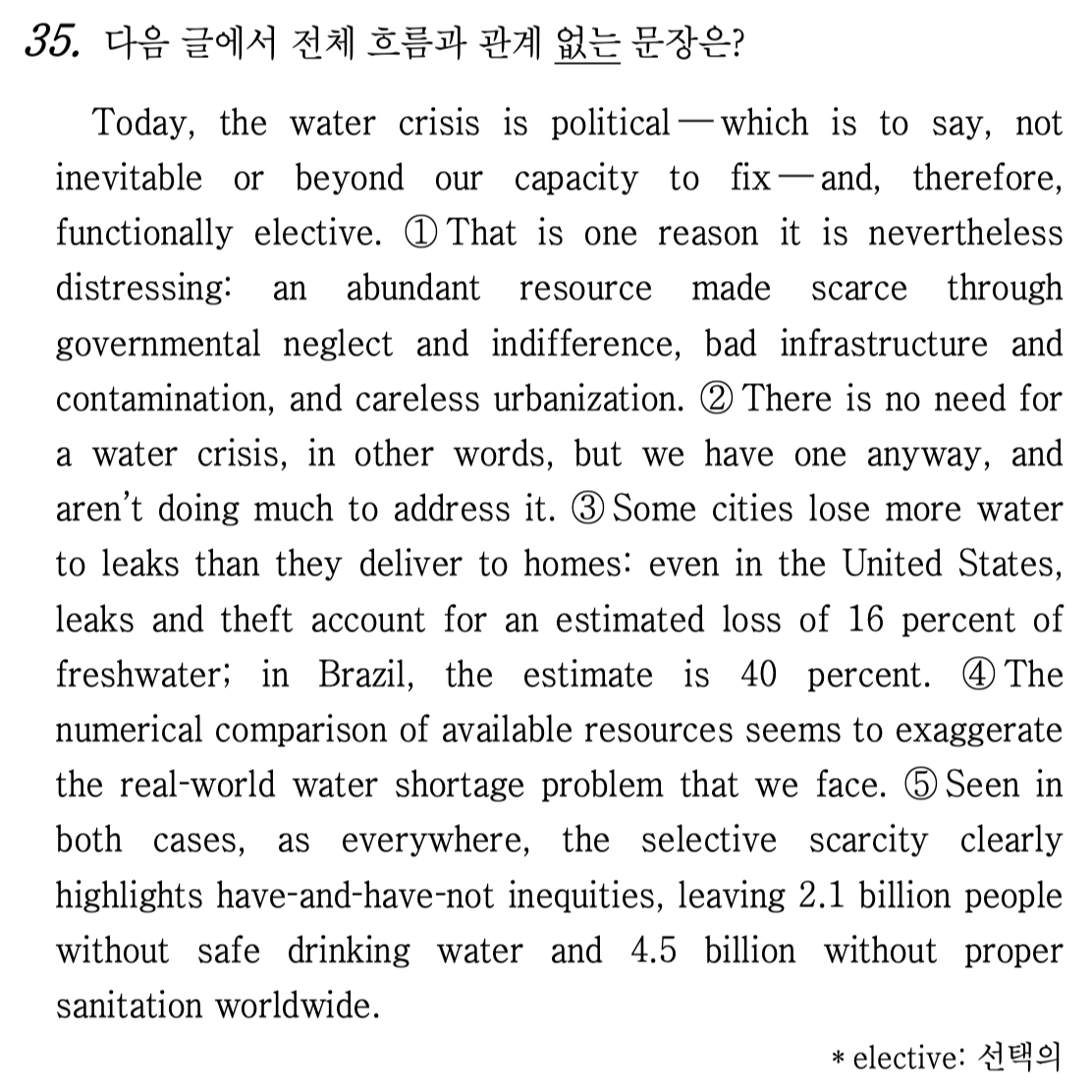
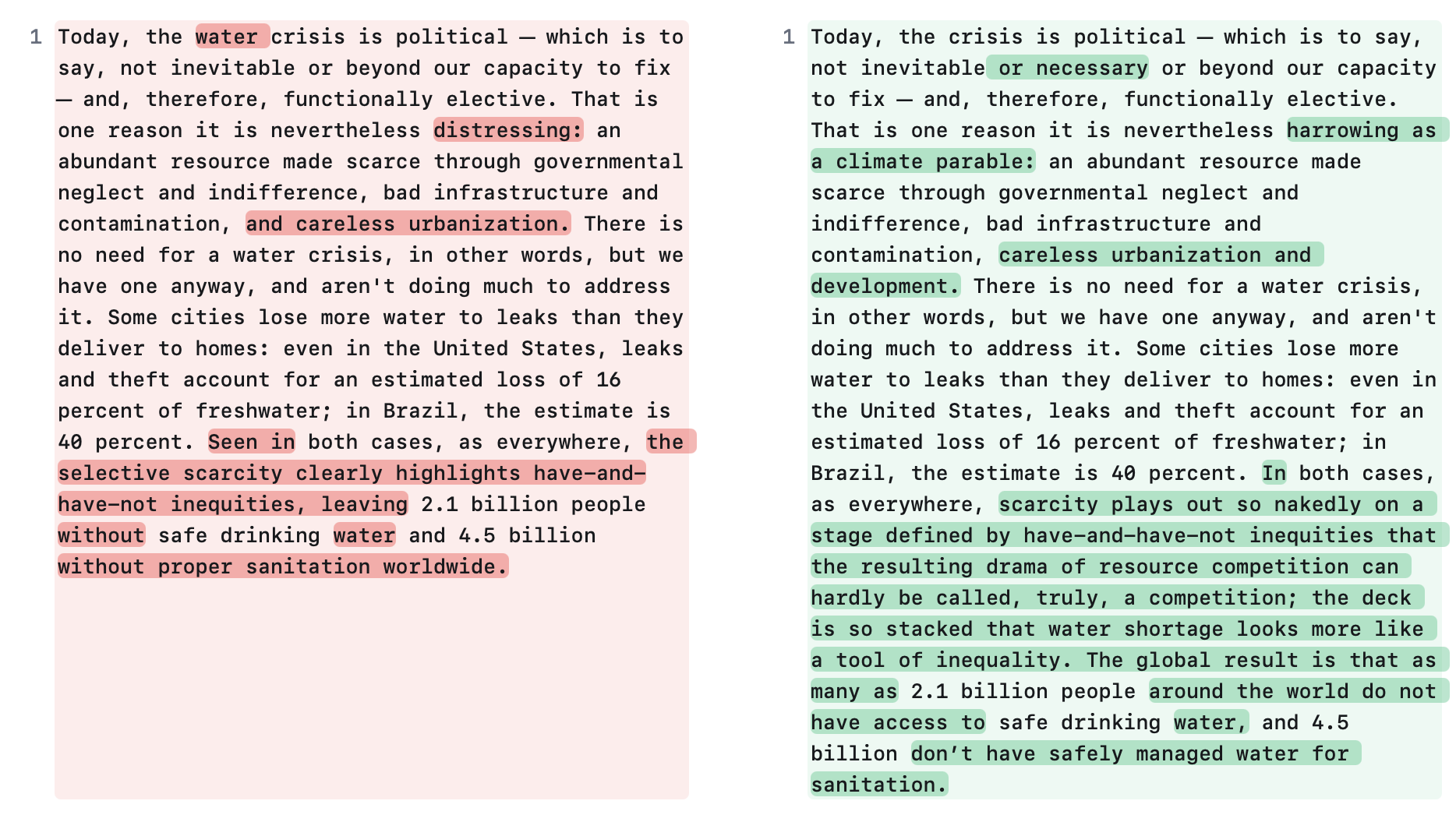
Today, the water crisis is political ─ which is to say, not inevitable or beyond our capacity to fix ─ and, therefore, functionally elective. That is one reason it is nevertheless distressing: an abundant resource made scarce through governmental neglect and indifference, bad infrastructure and contamination, and careless urbanization. There is no need for a water crisis, in other words, but we have one anyway, and aren't doing much to address it. Some cities lose more water to leaks than they deliver to homes: even in the United States, leaks and theft account for an estimated loss of 16 percent of freshwater; in Brazil, the estimate is 40 percent. Seen in both cases, as everywhere, the selective scarcity clearly highlights have-and-have-not inequities, leaving 2.1 billion people without safe drinking water and 4.5 billion without proper sanitation worldwide.
문제와 원문 출처 (링크 바로가기 클릭)

원문 텍스트 및 OCR
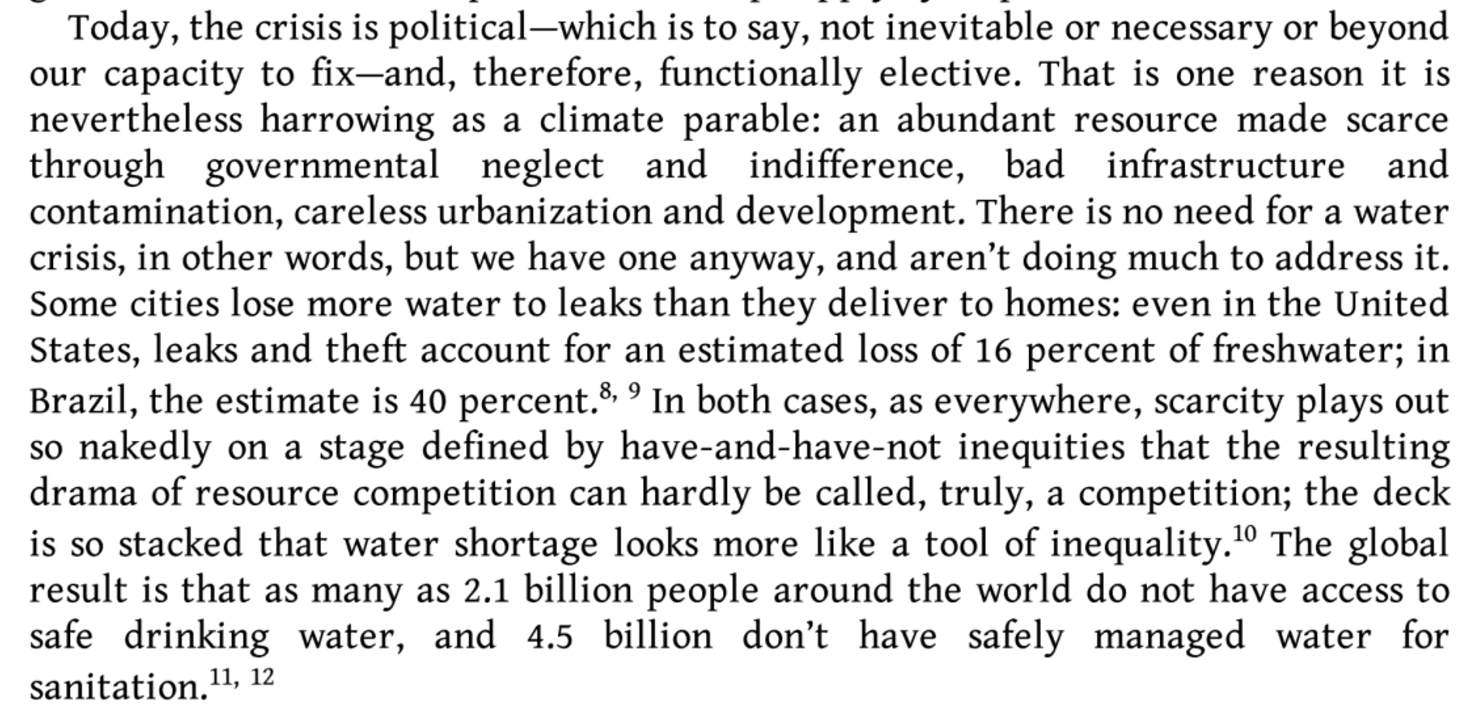 |
Today, the crisis is political—which is to say, not inevitable or necessary or beyond our capacity to fix—and, therefore, functionally elective. That is one reason it is nevertheless harrowing as a climate parable: an abundant resource made scarce through governmental neglect and indifference, bad infrastructure and contamination, careless urbanization and development. There is no need for a water crisis, in other words, but we have one anyway, and aren’t doing much to address it. Some cities lose more water to leaks than they deliver to homes: even in the United States, leaks and theft account for an estimated loss of 16 percent of freshwater; in Brazil, the estimate is 40 percent. In both cases, as everywhere, scarcity plays out so nakedly on a stage defined by have-and-have-not inequities that the resulting drama of resource competition can hardly be called, truly, a competition; the deck is so stacked that water shortage looks more like a tool of inequality. The global result is that as many as 2.1 billion people around the world do not have access to safe drinking water, and 4.5 billion don’t have safely managed water for sanitation. |
텍스트 비교 (문제 텍스트 vs. 원문 텍스트)
[고1] 2024년 10월 – 36번: 사회적 압력이 자존감 및 사회적 행동에 미치는 영향
As individuals, our ability to thrive depended on how well we navigated relationships in a group. If the group valued us, we could count on support, resources, and probably a mate. If it didn't, we might get none of these merits. It was a matter of survival, physically and genetically. Over millions of years, the pressure selected for people who are sensitive to and skilled at maximizing their standing. The result was the development of a tendency to unconsciously monitor how other people in our community perceive us. We process that information in the form of self-esteem and such related emotions as pride, shame, or insecurity. These emotions compel us to do more of what makes our community value us and less of what doesn't. And, crucially, they are meant to make that motivation feel like it is coming from within. If we realized, on a conscious level, that we were responding to social pressure, our performance might come off as grudging or cynical, making it less persuasive.
문제와 원문 출처 (링크 바로가기 클릭)


원문 텍스트 및 OCR
 |
Human beings are some of the most complex social animals on earth. We evolved to live in leaderless collectives far larger than those of our fellow primates: up to about 150 members. As individuals, our ability to thrive depended on how well we navigated those 149 relationships—not to mention all of our peers’ relationships with one another. If the group valued us, we could count on support, resources, and probably a mate. If it didn’t, we might get none of those. It was a matter of survival, physically and genetically. Over millions of years, those pressures selected for people who are sensitive to and skilled at maximizing their standing. It’s what the anthropologist Brian Hare called “survival of the friendliest.” The result was the development of a sociometer: a tendency to unconsciously monitor how other people in our community seem to perceive us. We process that information in the form of self-esteem and such related emotions as pride, shame, or insecurity. These emotions compel us to do more of what makes our community value us and less of what doesn’t. And, crucially, they are meant to make that motivation feel like it is coming from within. If we realized, on a conscious level, that we were responding to social pressure, our performance might come off as grudging or cynical, making it less persuasive. |
텍스트 비교 (문제 텍스트 vs. 원문 텍스트)

[고1] 2024년 10월 – 37번: 의식의 문제로 우울증의 원인을 재정의하는 설명
Conventional medicine has long believed that depression is caused by an imbalance of neurotransmitters in the brain. However, there is a major problem with this explanation. This is because the imbalance of substances in the brain is a consequence of depression, not its cause. In other words, depression causes a decrease in brain substances such as serotonin and noradrenaline, not a decrease in brain substances causes depression. In this revised cause-and-effect, the key is to reframe depression as a problem of consciousness. Our consciousness is a more fundamental entity that goes beyond the functioning of the brain. The brain is no more than an organ of consciousness. If it is not consciousness itself, then the root cause of depression is also a distortion of our state of consciousness: a consciousness that has lost its sense of self and the meaning of life. Such a disease of consciousness may manifest itself in the form of depression.
문제와 원문 출처 (링크 바로가기 클릭) - 구글 검색 불가

원문 텍스트 및 OCR
텍스트 비교 (문제 텍스트 vs. 원문 텍스트)
[고1] 2024년 10월 – 38번: 심리학이 인간 행동을 과학적으로 연구하는 방법 설명
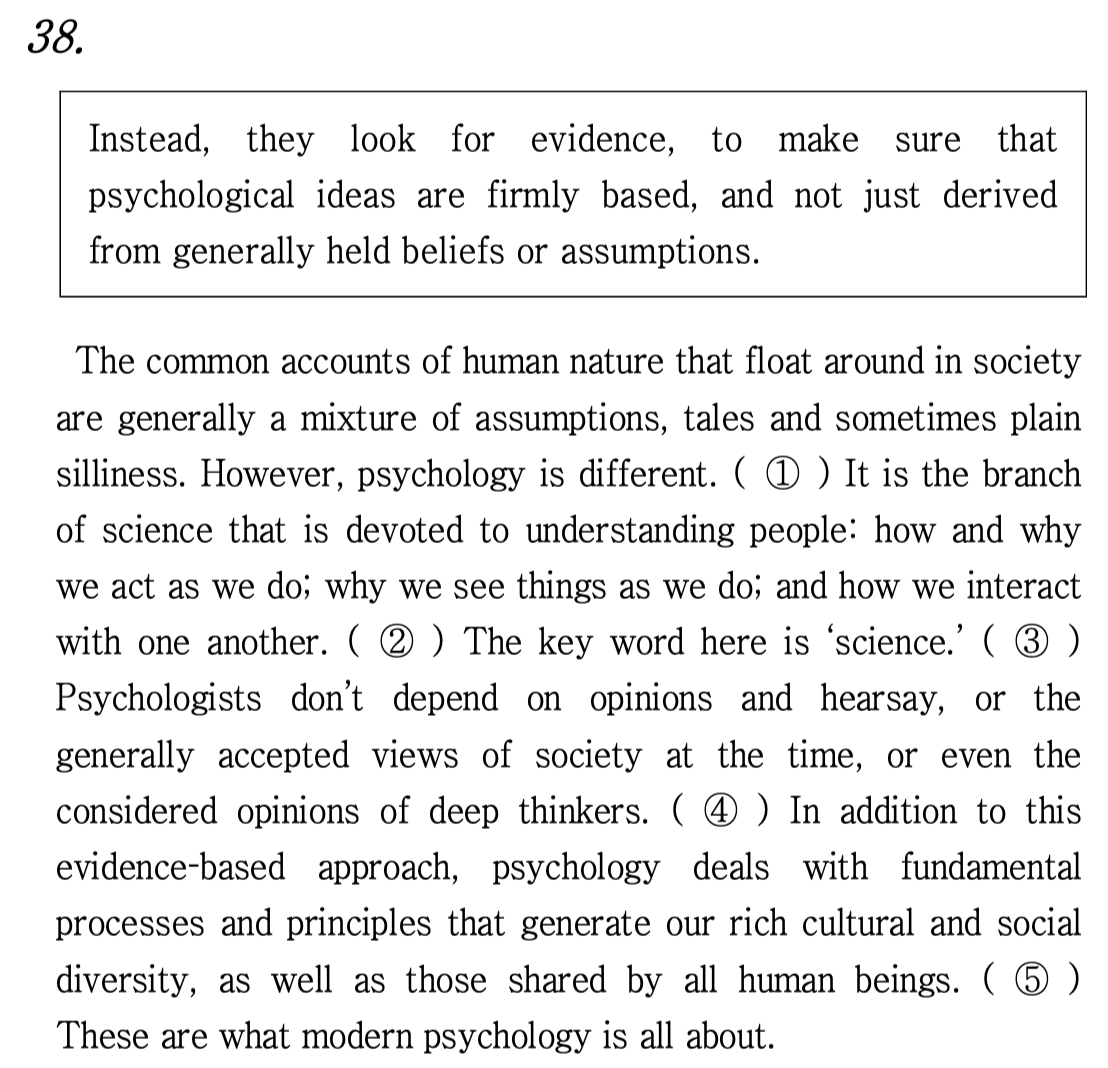
The common accounts of human nature that float around in society are generally a mixture of assumptions, tales and sometimes plain silliness. However, psychology is different. It is the branch of science that is devoted to understanding people: how and why we act as we do; why we see things as we do; and how we interact with one another. The key word here is 'science.' Psychologists don't depend on opinions and hearsay, or the generally accepted views of society at the time, or even the considered opinions of deep thinkers. Instead, they look for evidence, to make sure that psychological ideas are firmly based, and not just derived from generally held beliefs or assumptions. In addition to this evidence-based approach, psychology deals with fundamental processes and principles that generate our rich cultural and social diversity, as well as those shared by all human beings. These are what modern psychology is all about.
문제와 원문 출처 (링크 바로가기 클릭)

원문 텍스트 및 OCR
  |
In the Beginning The Greeks, Galen and the Influence of the East Psychology is fascinating and, in many ways, it is at the heart of being human. After all, understanding – or trying to understand – other people’s minds and behaviour is something all of us do every day. It’s how we get along in families, social groups and societies. And, quite often, we get it wrong. We might think we know what other people are like, and then we’re astounded when they don’t seem to see things as we do, or they behave in a strange (to us) way. We form ideas about human nature around what we have read or watched, which can be misleading. We often fail to appreciate that our understanding of people is rooted in our particular time, place and culture, and might not apply to others. Or we take for granted beliefs that people have held for millennia, without questioning where they came from. The common accounts of human nature that float around in society are generally a mixture of assumption, anecdote and sometimes plain silliness. Psychology is different. Psychology is the branch of science that is devoted to understanding people: how and why we act as we do; why we see things as we do; and how we interact with one another. The key word here is ‘science’. Psychologists don’t depend on opinions and hearsay, or the generally accepted views of society at the time, or even the considered opinions of deep thinkers. Instead, we look for evidence, to make sure that psychological ideas are firmly based, and not just derived from generally held beliefs or conjecture. As different as human beings are, there are processes and principles that we all have in common, and there are processes and principles that produce our wonderful cultural and social differences. These are what modern psychology is all about. |
텍스트 비교 (문제 텍스트 vs. 원문 텍스트)

[고1] 2024년 10월 – 39번: 생물학적 채널화 이론을 통한 질병과 건강의 표현 방식
Life is what physicists might call a 'high-dimensional system,' which is their fancy way of saying that there's a lot going on. In just a single cell, the number of possible interactions between different molecules is enormous. Such a system can only hope to be stable if only a smaller number of collective ways of being may emerge. For example, it is only a limited number of tissues and body shapes that may result from the development of a human embryo. In 1942, the biologist Conrad Waddington called this drastic narrowing of outcomes canalization. The organism may switch between a small number of well-defined possible states, but can't exist in random states in between them, rather as a ball in a rough landscape must roll to the bottom of one valley or another. We'll see that this is true also of health and disease: there are many causes of illness, but their manifestations at the physiological and symptomatic levels are often strikingly similar.
문제와 원문 출처 (링크 바로가기 클릭) - 구글 검색 불가

원문 텍스트 및 OCR
텍스트 비교 (문제 텍스트 vs. 원문 텍스트)
[고1] 2024년 10월 – 40번: '트릭 처벌'이 아동 행동에 부정적 영향을 미치는 이유
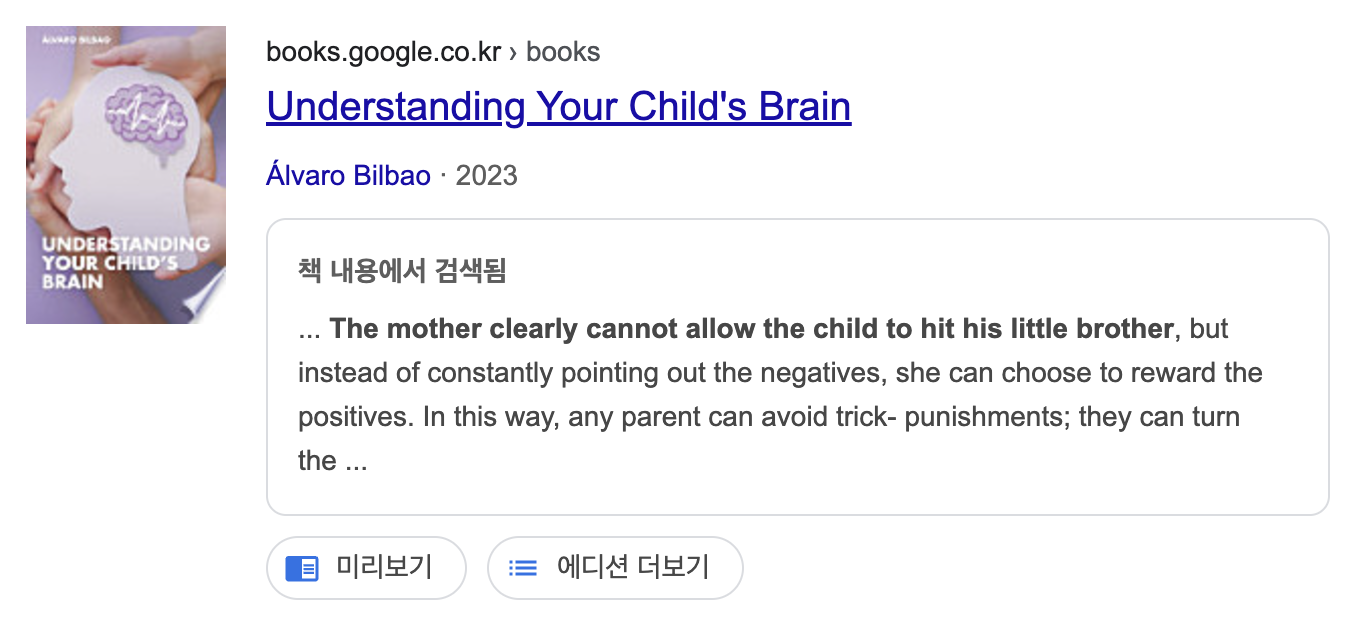
Punishing a child may not be effective due to what Alvaro Bilbao, a neuropsychologist, calls 'trick-punishments.' A trick-punishment is a scolding, a moment of anger or a punishment in the most classic sense of the word. Instead of discouraging the child from doing something, it encourages them to do it. For example, Hugh learns that when he hits his little brother, his mother scolds him. For a child who feels lonely, being scolded is much better than feeling invisible, so he will continue to hit his brother. In this case, his mother would be better adopting a different strategy. For instance, she could congratulate Hugh when he has not hit his brother for a certain length of time. The mother clearly cannot allow the child to hit his little brother, but instead of constantly pointing out the negatives, she can choose to reward the positives. In this way, any parent can avoid trick-punishments.
문제와 원문 출처 (링크 바로가기 클릭)

원문 텍스트 및 OCR
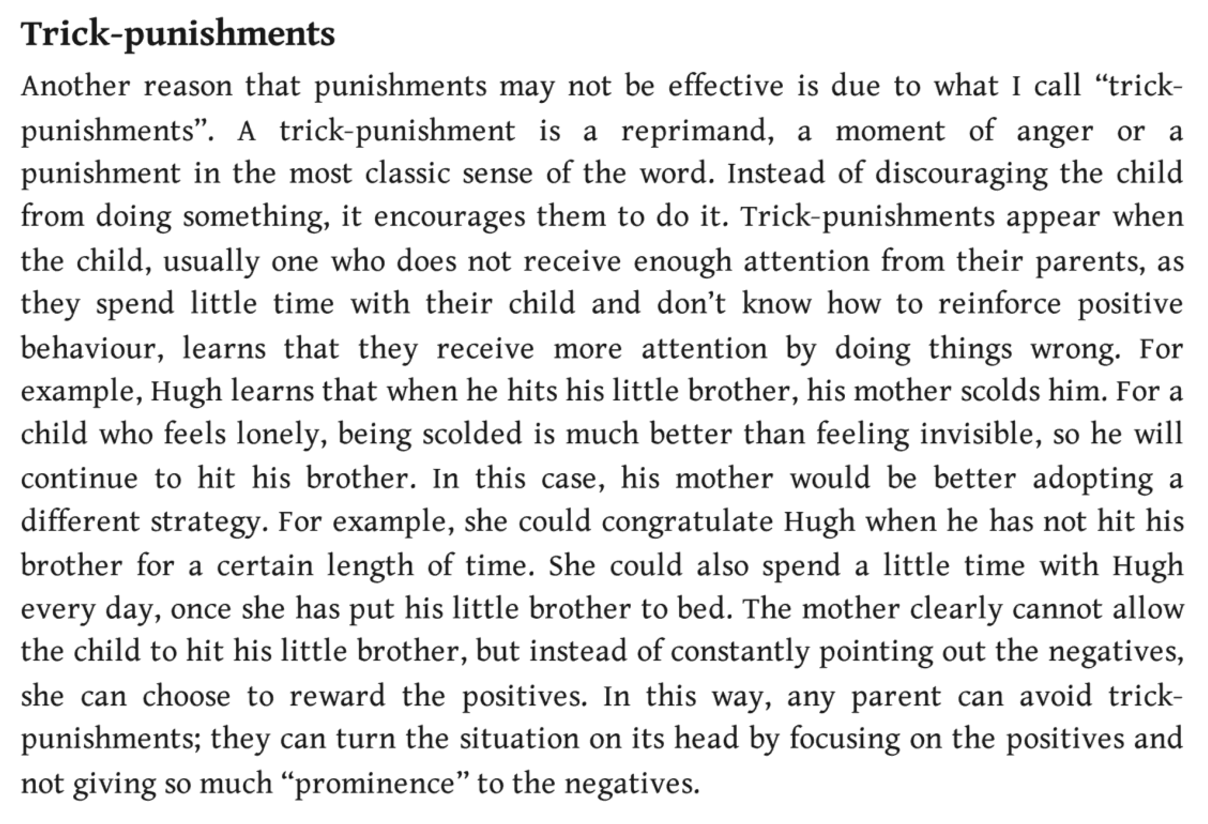 |
Trick-punishments Another reason that punishments may not be effective is due to what I call “trick-punishments”. A trick-punishment is a reprimand, a moment of anger or a punishment in the most classic sense of the word. Instead of discouraging the child from doing something, it encourages them to do it. Trick-punishments appear when the child, usually one who does not receive enough attention from their parents, as they spend little time with their child and don’t know how to reinforce positive behaviour, learns that they receive more attention by doing things wrong. For example, Hugh learns that when he hits his little brother, his mother scolds him. For a child who feels lonely, being scolded is much better than feeling invisible, so he will continue to hit his brother. In this case, his mother would be better adopting a different strategy. For example, she could congratulate Hugh when he has not hit his brother for a certain length of time. She could also spend a little time with Hugh every day, once she has put his little brother to bed. The mother clearly cannot allow the child to hit his little brother, but instead of constantly pointing out the negatives, she can choose to reward the positives. In this way, any parent can avoid trick-punishments; they can turn the situation on its head by focusing on the positives and not giving so much “prominence” to the negatives. |
텍스트 비교 (문제 텍스트 vs. 원문 텍스트)

[고1] 2024년 10월 – 41~42번: 인간이 생존을 위해 애매한 대상에도 의도를 부여하는 경향
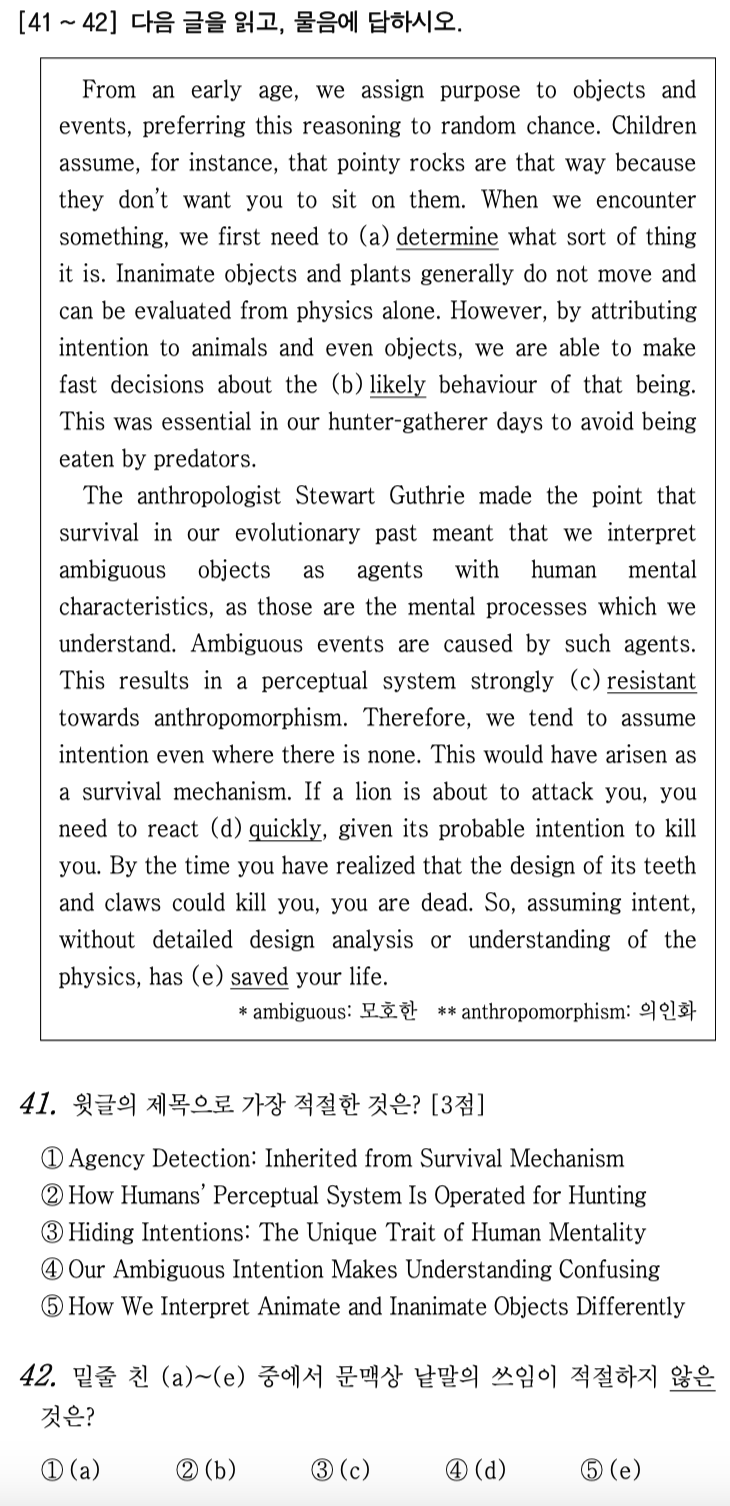
From an early age, we assign purpose to objects and events, preferring this reasoning to random chance. Children assume, for instance, that pointy rocks are that way because they don't want you to sit on them. When we encounter something, we first need to determine what sort of thing it is. Inanimate objects and plants generally do not move and can be evaluated from physics alone. However, by attributing intention to animals and even objects, we are able to make fast decisions about the likely behaviour of that being. This was essential in our hunter-gatherer days to avoid being eaten by predators. The anthropologist Stewart Guthrie made the point that survival in our evolutionary past meant that we interpret ambiguous objects as agents with human mental characteristics, as those are the mental processes which we understand. Ambiguous events are caused by such agents. This results in a perceptual system strongly biased towards anthropomorphism. Therefore, we tend to assume intention even where there is none. This would have arisen as a survival mechanism. If a lion is about to attack you, you need to react quickly, given its probable intention to kill you. By the time you have realized that the design of its teeth and claws could kill you, you are dead. So, assuming intent, without detailed design analysis or understanding of the physics, has saved your life.
문제와 원문 출처 (링크 바로가기 클릭)

원문 텍스트 및 OCR
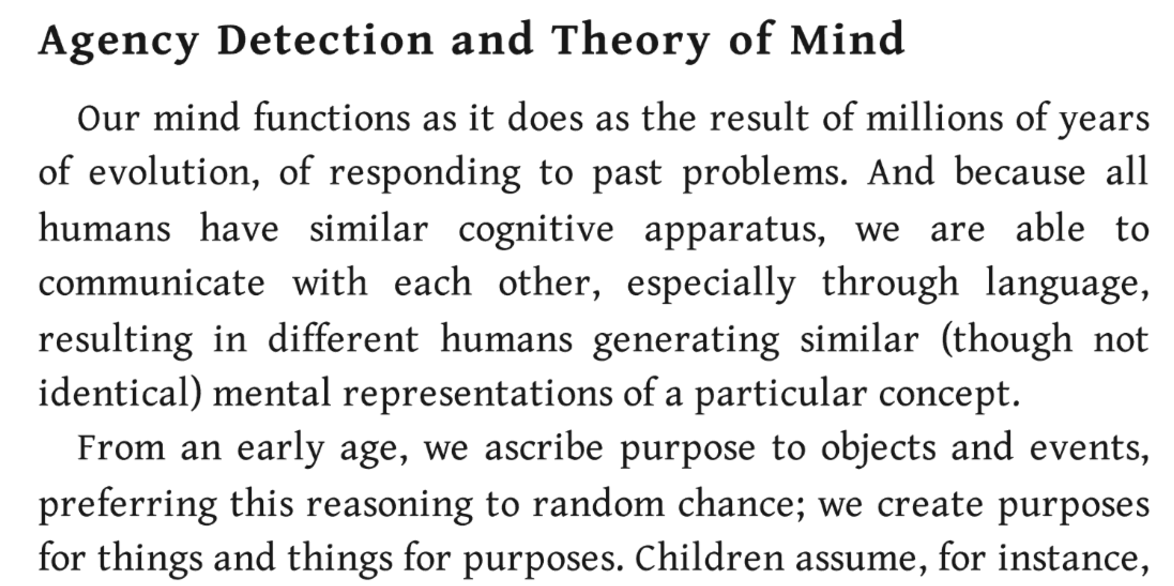  |
Agency Detection and Theory of Mind Our mind functions as it does as the result of millions of years of evolution, of responding to past problems. And because all humans have similar cognitive apparatus, we are able to communicate with each other, especially through language, resulting in different humans generating similar (though not identical) mental representations of a particular concept. From an early age, we ascribe purpose to objects and events, preferring this reasoning to random chance; we create purposes for things and things for purposes. Children assume, for instance, that pointy rocks are that way because they don’t want you to sit on them. When we encounter something, we first need to determine what sort of thing it is. Inanimate objects and plants generally do not move and can be evaluated from physics alone. However, by assuming a design purpose or, even more effectively, imputing intention to animals, other humans, and even objects, we are able to make fast decisions about the likely behaviour of that being. This was essential in our hunter-gatherer days to avoid being eaten by predators. The anthropologist Stewart Guthrie made the point that survival in our evolutionary past meant that we interpret ambiguous objects as agents with human mental characteristics, as those are the mental processes which we understand. Ambiguous events are caused by such agents. This results in a perceptual system strongly biased towards anthropomorphism. As a result, we tend to assume intention even where there is none. This would have arisen as a survival mechanism, aided by a theory of mind. If a lion is about to attack you, you need to react quickly, given its likely intention to kill you. By the time you have determined that the design of its teeth and claws could kill you, or calculated the physics of the working of its body when it leaps on you, you are dead. So, assuming intent, without detailed design analysis or understanding of the physics, has saved your life. |
텍스트 비교 (문제 텍스트 vs. 원문 텍스트)

관련 자료 바로가기
[고1] 2024년 10월 모의고사 - 지문 출처 (20~24번)
[고1] 2024년 10월 – 20번: 가사활동에 운동을 통합하여 건강을 증진하는 방법 제안 For many of us, making time for exercise is a continuing challenge. Between work commitments and family obligations, it often feels like t
flowedu.tistory.com
[고1] 2024년 10월 모의고사 - 지문 출처 (29~34번)
[고1] 2024년 10월 – 29번: 디지털 기술이 어떻게 사용자의 인식을 강력하게 변화시키는지 설명 Digital technologies are essentially related to metaphors, but digital metaphors are different from linguistic ones in im
flowedu.tistory.com
'[고1] 영어 모의고사 자료 > [고1] 24년 10월 자료' 카테고리의 다른 글
| [고1] 2024년 10월 모의고사 - 영어지문요약 with images (by gemini-2.5-pro) (0) | 2025.12.03 |
|---|---|
| [고1] 2024년 10월 모의고사 - 지문 출처 (29~34번) (0) | 2024.11.11 |
| [고1] 2024년 10월 모의고사 - 지문 출처 (20~24번) (1) | 2024.11.11 |
| [고1] 2024년 10월 모의고사 - 지문 요약 by ChatGPT-4o (1) | 2024.10.21 |
| [고1] 2024년 10월 모의고사 - 한줄해석 (좌지문 우해석) (2) | 2024.10.19 |
| [고1] 2024년 10월 모의고사 - 한줄해석 (0) | 2024.10.19 |
커피 한잔의 후원은 콘텐츠 제작에 큰 힘이 됩니다
(모바일에서는 배너를 클릭해 주세요)